What everything on a board means
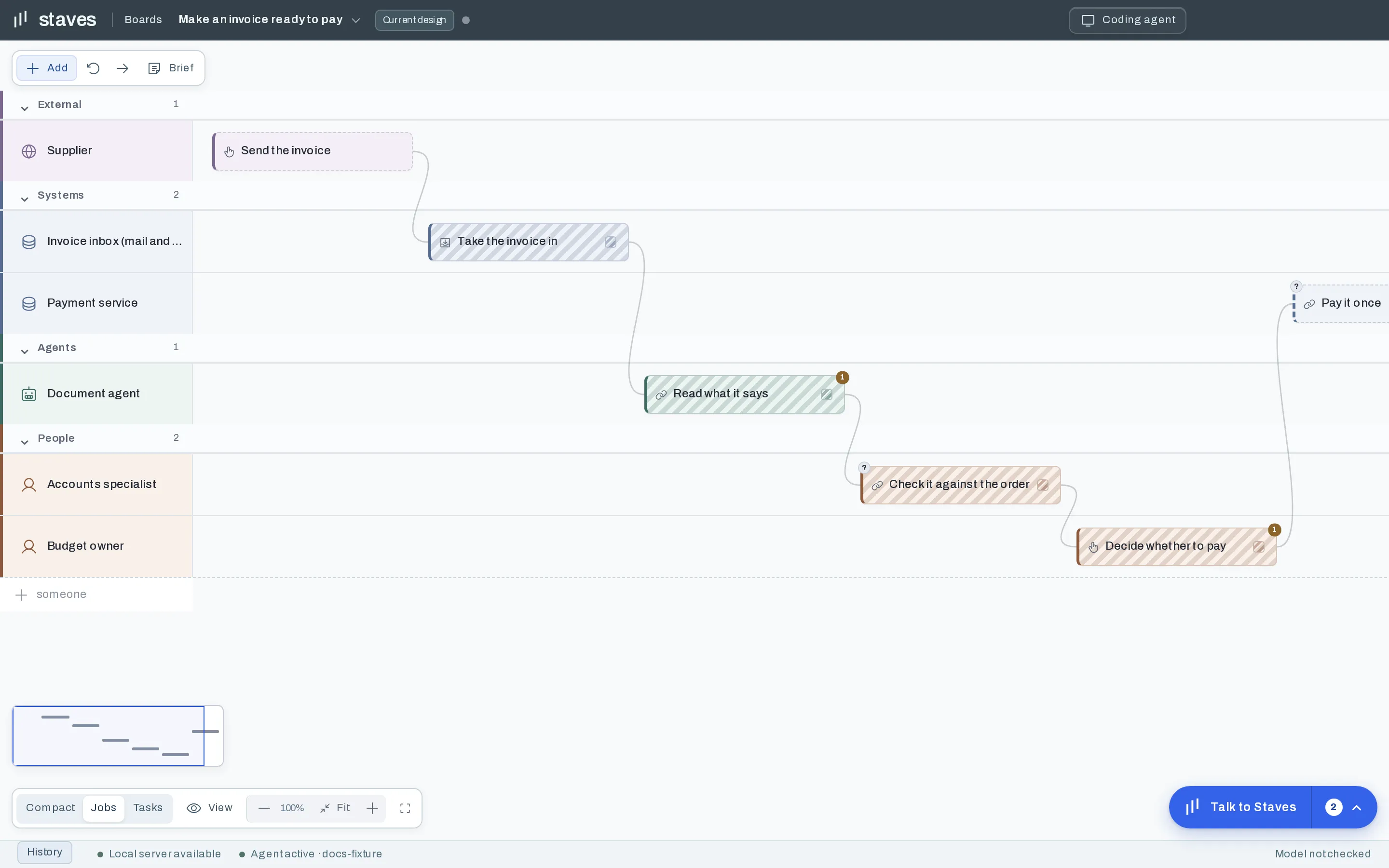
A board makes one claim: this is how the work happens. Everything on it exists to make that claim checkable.
Tracks — who contributes
Section titled “Tracks — who contributes”A track is a contributor, down the left. There are four kinds, and the distinction matters because it decides who can be waiting on something:
| Kind | Who that is |
|---|---|
| person | Someone inside the organisation doing the work |
| agent | A model doing work on someone’s behalf |
| system | Software that runs without judgement — a queue, a database, an API |
| outside | Someone beyond the organisation: a customer, a supplier, a regulator |
Jobs — what someone gets
Section titled “Jobs — what someone gets”A job is named by what a person has when it is done. Someone is waiting on it, and that someone is a person or an outside party — never a system. “Check it against the order”, not “validateInvoice”.
If only another step waits on it, it is not a job. It is a task inside one.
Each job can carry:
- Intended result — what is different when it is done
- Who needs the result — the person waiting, and what they do with it next
- How you know it is complete — what you would actually check
- Why — the rationale, in the words of whoever explained it
A job with none of these is a draft: Staves keeps it and hands back the questions rather than refusing it.
Tasks — the work inside a job
Section titled “Tasks — the work inside a job”Tasks belong to a job and can sit on different tracks from it. That is the point: the job “Check it against the order” may contain an agent reading the document, a system matching it, and a person deciding — three tracks, one outcome.
Handoffs — what passes
Section titled “Handoffs — what passes”Handoffs are never drawn directly. They are derived from each job’s inputs and outputs, from its exit targets, and from where a loop goes back. If two jobs are joined on the canvas, it is because the board says so somewhere else — which means the line cannot lie about the flow.
Artifacts are what passes, and they have kinds: document, data, decision, message,
record, instruction, measure, other. An artifact marked external came from outside.
Triggers — what starts it
Section titled “Triggers — what starts it”| Trigger | Meaning |
|---|---|
hand | A person gets to it |
ask | Someone asks for it |
event | Something arrives |
chain | The previous job ends |
clock | A schedule |
watch | A condition becomes true |
deadline | Time runs out |
always | It never stops |
other | Said in words instead |
Trigger is worth arguing about. hand and chain look the same on a canvas and feel completely
different to the person waiting: one means when someone gets round to it, the other means
immediately.
Gates — where judgement happens
Section titled “Gates — where judgement happens”A gate is a decision point: the rule in words, and who is accountable for it — a track, or
rule when a rule decides rather than a person. A gate is how a board shows where human judgement
is actually required, as opposed to where it merely happens to be.
Status, and what is actually built
Section titled “Status, and what is actually built”Two different things, deliberately kept apart:
- Status —
draftuntil a person signs it off,confirmedafter. A confirmed job is never silently redrawn; a re-description comes back as a proposal. - Implementation —
unknown,planned,in-progress,implemented. This is about the code, not the description. It is how a board shows intent without pretending intent has shipped.
Questions and findings
Section titled “Questions and findings”A question is something nobody knows, attached to the job it concerns. A board with no questions usually means something was invented rather than found.
A finding is something Staves noticed: jargon, a job reached from two places, work that produces something and checks nothing.
A job is stale when the files it was described from have changed since. It does not mean the description is wrong — only that nobody has checked. See picking a board back up.