What Staves is for
Staves draws the work of a project as a board: people, agents, systems and outside parties on tracks, with jobs between the handoffs. It answers a question that is otherwise expensive to answer — who does what here, what passes between them, and where does it stall — and keeps the answer true as the code changes.
What a board is
Section titled “What a board is”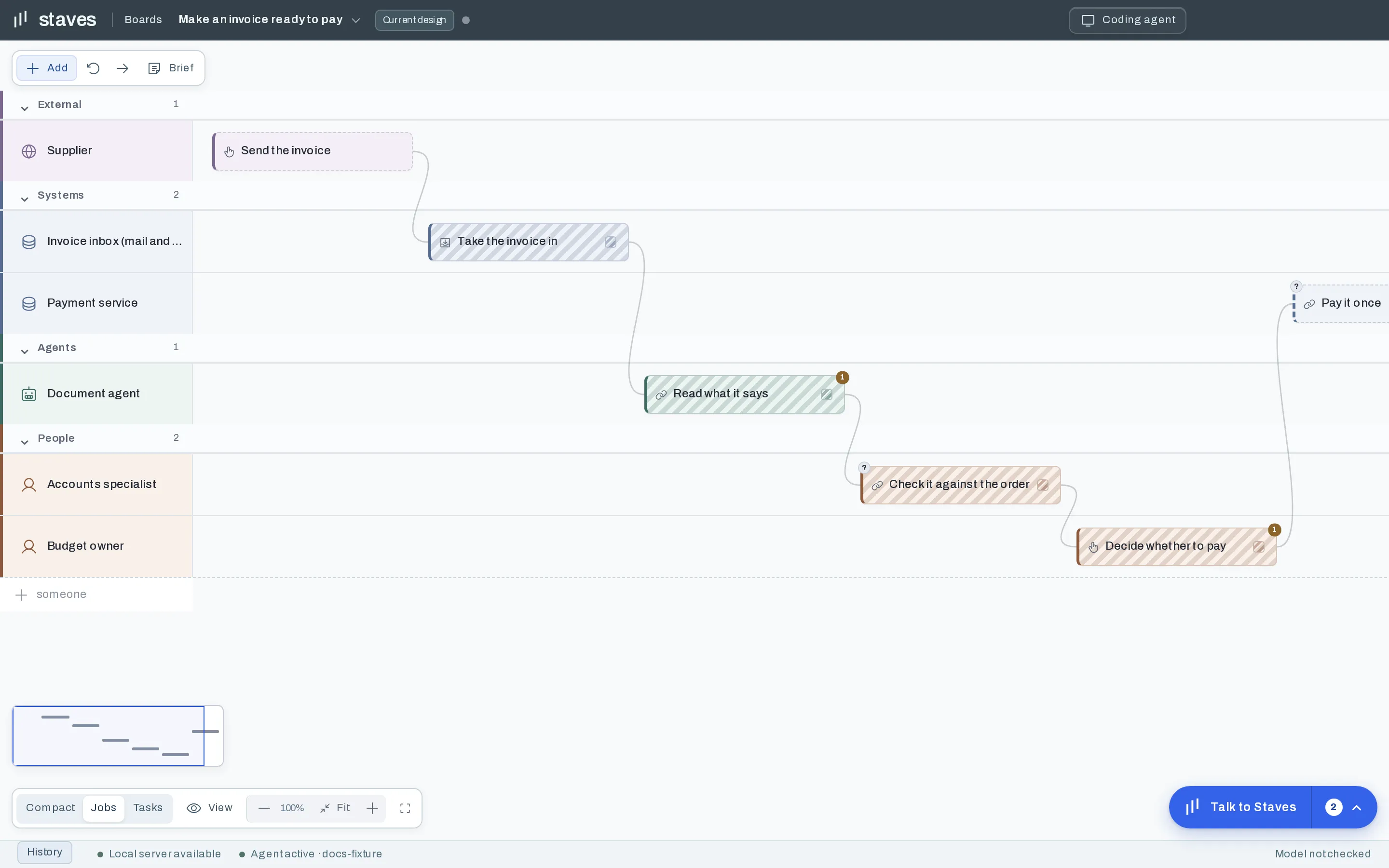
A worked example, not anyone’s real workflow. These images are regenerated from the running interface, so what you see here is what you will get.
A job describes something achieved for a person. Its tasks describe the work needed to achieve it, and they can belong to different roles — people, agents, systems. Tracks keep those responsibilities visible. Handoffs are what passes between them.
Each job is written so a stranger could do it by hand and get the same result and the same failures. That is the test.
What a board is not
Section titled “What a board is not”A board is a description, not a live trace of production. It does not execute your services, and a walkthrough is design exploration rather than a recording of what happened. Where the code cannot tell you something, a board carries an open question rather than a confident invention — an unanswered question is worth more than a guess that reads as fact.
Who draws it
Section titled “Who draws it”Usually the coding agent you already use. It reads the code on your machine and writes only its description of the work to the board; Staves never sees your repository. You can also be interviewed in the browser, which needs no repository and no agent, but does need an AI key.
Desktop and mobile
Section titled “Desktop and mobile”Use desktop to design and remodel workflows, by conversation or directly on the canvas. A phone reads one board opened from a shared link and copies the link to continue on a computer; there is no board list on a phone. See Design through conversation.